




 Red wine
 White wine
 Rosé wine
 Wines en primeur
 Sherry and Port wine
 Sweet wine
 Orange wine
 Vermouth
 Champagne
 Cava
Cava Prosecco
 Lambrusco
 Crémant
 Moscato d'Asti
 Franciacorta
 Pet-Nat
 Corpinnat
 Other sparkling wines
 Rhum
Rhum Gin
Gin Whisky
 Vodka
Vodka Cognac
 Brandy
 Pastis
 Tequila
 Mezcal
 Grappa and Eau de vie
 Calvados
 Liqueurs
 Pacharán
 Apéritifs
 Wine gift boxes
 Boxed wines
 Boxed sparkling wines
 Wine bottles and glasses
 Gift card
 Non alcoholic Wine
 Non alcoholic Sparkling wine
 Non alcoholic Gin
 Other non-alcoholic drinks
 Aromas
 Wine conservation
 Decanters and aerators
 Bottle identifiers
 Corkscrews
 Service
 Glass identifiers
 Cleaners
 Accessories set
 Wine glasses
 Contact

Vineyard zoning is slowly becoming a reality
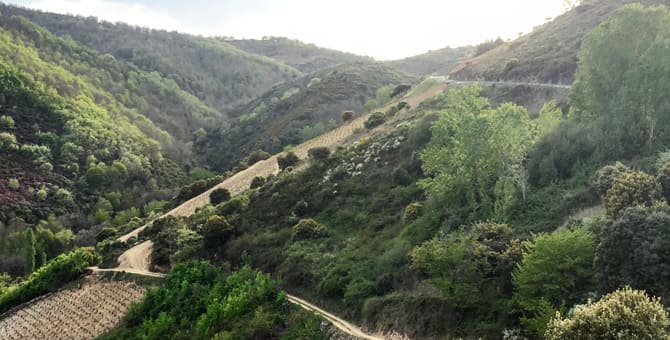
In recent times, in many Denominations of Origin (D.O.) they are claiming for a change when it comes to classifying subareas and labelling wines. Each day, there are more and more voices, especially of traditional producers, who wish to showcase the villages and sites where they cultivate, and the underlying features of each subarea.
Under this principle, in several regions they are trying to implement a territorial distribution that creates a quality pyramid, enabling the interpretation of the different types of wines. The pyramid would start with the wines from different subareas (or villages), then move on to single-site wines or ‘vinos de paraje’, and end with single-vineyard wines or ‘vinos de finca’. This classification system is similar to the one that has been used in Burgundy for many, many years.
The first D.O. to start implementing this model has been D.O. Bierzo. In this region, they have promoted the zoning of the territory. The labels of the wines from this DO will indicate their origin. To do so, the different soils that comprise this region were analysed. The aim was to differentiate the characteristics of each subarea and village and, especially, to detect those farms that had a distinguishing value. The yields per hectare along with the minimum age of the vineyard have also been specified.
The geographical units, according to data provided by D.O. Bierzo, are the following:
Vino de la Región.- It is the current geographical delimitation of Denomination of Origin Bierzo. It literally means ‘wine from the region’.
Vino de Villa.- 100% of the grapes used must come from plots that belong to a specific municipality or district. The yield of grapes (kg/ha) will be 20% less than the maximum established by Denomination of Origin Bierzo.
Vino de Paraje.- 100% of the grapes that are used must come from the same site, the name of which must be recognised in the zoning map created by Denomination of Origin Bierzo called Parcelario de Aptitud. The yield of grapes (kg/ha) will be 25% less than the maximum established by Denomination of Origin Bierzo.
Vino de Viña Clasificada.- 100% of the grapes that are used must come from a same plot or plots that are surrounding one same site. The plots must be recognised in the zoning map or Parcelario de Aptitud of the Denomination of Origin Bierzo. These wines must have been classified as ‘vinos de viña’ for five years. Their quality must have also been recognised by the Committee of Experts of the Regulatory Council. The yield of grapes (kg/ha) will be 30% less than the maximum established by Denomination of Origin Bierzo.
Gran Vino de Viña Clasificada.- This kind is similar to the previous one, but the wines must have been classified as ‘vinos de viña’ for at least ten years. Their quality must have also been recognised by the Committee of Experts of the Regulatory Council. The yield of grapes (kg/ha) will be 35% less than the maximum established by Denomination of Origin Bierzo.
To understand this classification, we have the clear example of the wines by Descendientes de J. Palacios; in these wines we can distinguish the different zoning levels. In the first level we would find Pétalos del Bierzo as a wine reference in the Region. Next, Corullón, as a ‘vino de villa’, and then, three ‘vinos de paraje’: Moncerbal, Las Lamas and La Faraona. The last two aspire to become ‘vino de paraje’ after 5 years and, after 10 years, they could enter the classification as ‘gran vino de viña clasificada’.
D.O. Bierzo, as the pioneers, have created a model that many other Denominations of Origin are looking into to adjust it to their own characteristics. Other regions and denominations, such as D.O.Q. Priorat, have also moved forward in the concept of zoning, increasingly advocating for the terroir and its particularities. Rioja has already started working on it and has taken a step towards ‘vinos de pueblo’ (village wines), although they still have a lot of work to do.
At Decántalo, we believe it is positive for Spanish wine to put the great sites and terroirs that characterise us out into the world: from La Coma d’en Romeu, in Priorat; Quiñon de Valmira or las Beatas, in Rioja; Macharnudo with Inocente or La Charanga in Mahína, in the south; Rumbo al Norte in Sierra de Gredos, Táganan in Tenerife, and many other vineyards that transmit their singularities beyond the time the wine has spent in the barrel during its production.


